Regeneration of St Botolph's Circus, Colchester

St Botolph's and East Hill works
The page below sets out details on the St Botolph's Regeneration works being undertaken by Jackson Civil Engineering. The works are expected to take about 18 months and are scheduled to be completed in Autumn 2027.
The team are working closely with the East Hill project team, as well as Colchester City Council to ensure works are aligned. For the latest on the East Hill scheme visit www.essexhighways.org/east-hill.
To receive newsletter updates on both schemes please email colchestercitycentre@essexhighways.org
Subscribe for updates
.jpg) Did you know you can also receive updates directly to your phone through the St Botolph's WhatsApp channel? The team will share live works specific essentials, such as road closures and upcoming changes. Your details will remain private. Scan the QR code. The broadcast channel will open on Whatsapp and invite you to follow. Click ‘Follow channel’. Unmute to receive notifications as they come, or check the channel when it suits you. You will not be visible to other subscribers in this channel.
Did you know you can also receive updates directly to your phone through the St Botolph's WhatsApp channel? The team will share live works specific essentials, such as road closures and upcoming changes. Your details will remain private. Scan the QR code. The broadcast channel will open on Whatsapp and invite you to follow. Click ‘Follow channel’. Unmute to receive notifications as they come, or check the channel when it suits you. You will not be visible to other subscribers in this channel.
Works progress
The works at St Botolph's are expected to take 18 months to complete. The following slideshow shows weekly progress on the scheme For any questions about the works you can email the project team at stbotolphs@essexhighways.org.
Slideshow Instructions
- Add one image per row.
- Enter the image URL in the first column (from the relevant scheme folder).
- Add descriptive Alternative Text for accessibility (descibing the image).
- Add a caption.
- Set Include? to Yes or No.
- The slideshow will automatically use the first image marked Yes as the starting slide.
- At least one image must have Include? set to Yes.
- Add additional rows to the table by selecting where you want to add a row and using the right mouse key to show the contect menu, select row and insert above or below (you can also delete a row to remove the image from the slideshow).
| Image URL - Should be saved in a scheme folder! |
Alternative Text |
Caption |
Include? |
| /uploads/Highway-Schemes/Major-Schemes/St%20Botolphs/NCP%20VIEW%2008_10_2026.jpg |
Image of St Botolph's Circus roundabout on 8 October taken from NCP carpark |
Works Progress on 8.10.26 |
Yes |
| /uploads/Highway-Schemes/Major-Schemes/St%20Botolphs/NCP%20VIEW%2001_10_2026.jpg |
Image of St Botolph's Circus roundabout on 1 October taken from NCP carpark |
Works Progress on 1.10.26 |
Yes |
| /uploads/Highway-Schemes/Major-Schemes/St%20Botolphs/NCP%20VIEW%2018_09_2026.jpg |
Image of St Botolph's Circus roundabout on 18 September taken from NCP carpark |
Works Progress on 18.09.26 |
Yes |
| /uploads/Highway-Schemes/Major-Schemes/St%20Botolphs/NCP%20VIEW%2011_09_2026.jpg |
Image of St Botolph's Circus roundabout on 11 September taken from NCP carpark |
Works Progress on 11.09.26 |
Yes |
| /uploads/Highway-Schemes/Major-Schemes/St%20Botolphs/NCP%20VIEW%2002_09_26.jpg |
Image of St Botolph's Circus roundabout on 2 September taken from NCP carpark |
Works Progress on 2.09.26 |
Yes |
| /uploads/Highway-Schemes/Major-Schemes/St%20Botolphs/NCP%20VIEW%2021_08_26.jpg |
Image of St Botolph's Circus roundabout on 28 Auguest taken from NCP carpark |
Works Progress on 28.08.26 |
Yes |
Do not remove this line our anything under this line!
Do not remove this line our anything above this line!
Regeneration of St Botolph's Circus
As a key gateway into the city centre and a meeting point for different forms of transport, the regeneration of St Botolph’s Circus is a vital part of Colchester’s City Centre Masterplan. It forms part of a wider £40 million programme of investment across the city centre.
Funded through a successful Government funding bid, the regeneration of St Botolph’s will improve the area and lay the foundation for future enhancements, including the delivery of a new bus transport interchange.
The funding bid highlights the need to create a new gateway into the city centre that supports regeneration, stimulates business growth, and improves health and wellbeing.
Why this scheme is important
It has been long acknowledged that the St Botolph’s Circus area requires improvement, and early designs were first consulted on in 2019. As an important gateway into the city centre, and a meeting point of drivers, pedestrians, cyclists, bus and train users the successful funding bid recognised the importance of improving the area.
The key issues with St Botolph’s Circus are:
- It has poor connectivity – It is a meeting point for cars, pedestrians, cyclists, trains and public transport, but does not effectively cater for people changing between types of transport or trying to access the city centre or local amenities.
- It contributes to a splitting of communities – It separates those living south of the junction from the city centre.
- It has poor accessibility – It does not cater for the movement of people who are unable to use the steps/ramps, offering indirect, longer and un-signalised crossing alternatives.
- It has poor air quality – It is road dominated, causing air quality issues, with Mersea Road designated an ‘Air Quality Management Area’.
- It suffers from anti-social behaviour and can feel unsafe – The unattractive subways and isolated location can feel unsafe and there have been historic reported instances of anti-social behaviour and crime in the area. The subways are poorly lit and can feel intimidating, particularly at night.
- It is an under-utilised local area − The St Botolph’s Circus area does not provide the gateway feel to the city centre it should and is a lost opportunity for local economic growth. The lack of high-quality public realm and poor use of space discourages footfall and people spending time in the area, which impacts local businesses. It also restricts access to local heritage sites such as St Botolph’s Priory.
What the area will look like when complete
The design being taken forward will see the area transformed. Key elements of the design include:
- Removal of the outdated underpasses to help improve accessibility and safety for pedestrians.
- New surface-level crossing points on each arm of the junction, making it easier and safer to access the city centre.
- The creation of new high-quality plaza areas to improve pedestrian experience and remove pinch-points.
- Space for a kiosk /pop-up business opportunity maximising the economic opportunity offered by increasing footfall./li>
- Dedicated cycling facilities to create a better balance between road users and connect cyclists to the wider network.
- New landscaping and public realm to improve the look and feel of the area and create an area people can spend time in.
The below artist's impressions and 'fly-through' video above show a glimpse of what the future of St Botolph’s Circus will look like:
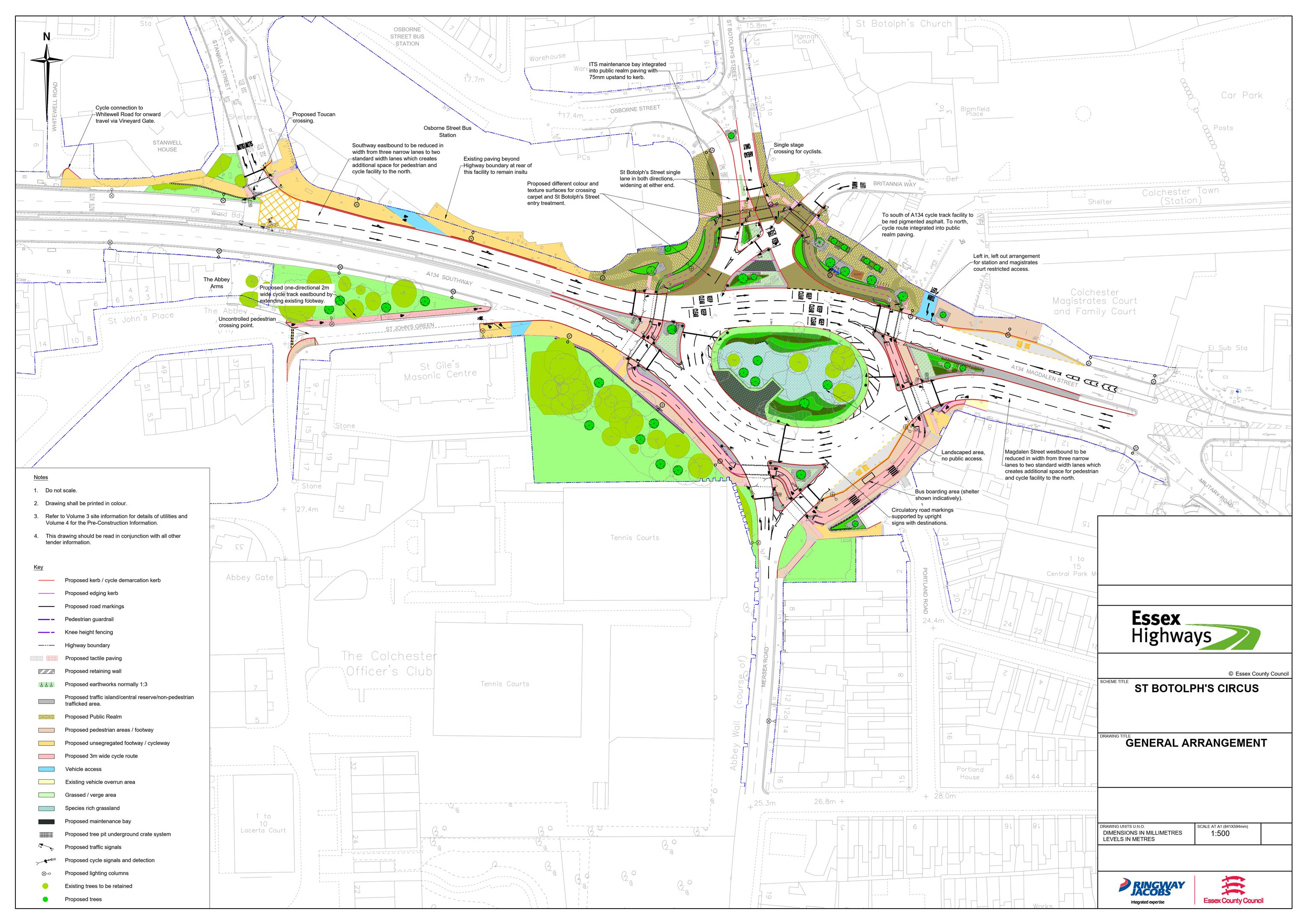
Plan of the works
Contact the team
For any questions about the St Botolph's Circus scheme please contact the project team at: stbotolphs@essexhighways.org.
Questions and Answers
Scheme overview
As an important gateway into the city centre, the works will regenerate the junction area, improving safety, accessibility and connectivity.
This will see the existing roundabout made smaller, and the highway narrowed to create more space for pedestrians in what is a high footfall area. The outdated subways will be removed, with surface-level signalised crossings for pedestrians and cycles installed on each arm of the roundabout, making it easier for pedestrians to travel across the junction. The roundabout itself will be landscaped with no public access.
The creation of new plaza areas, with high-quality materials and landscaping, will improve the look and feel of the area. There is also space being created for a kiosk /pop-up business opportunity.
Creating a better balance between different road users, dedicated cycling facilities will be provided connecting to the existing cycle network, and a larger bus stop area towards Mersea Road will cater for bus users, segregated from pedestrians and cyclists.
It has been long acknowledged that the St Botolph’s Circus area requires improvement, and early designs were first consulted on in 2019.
As an important gateway into the city centre, and a meeting point of drivers, pedestrians, cyclists, bus and train users the successful funding bid recognised the importance of improving the area.
The key issues with St Botolph’s Circus currently are:
- It has poor connectivity – It is a meeting point for cars, pedestrians, cyclists, trains and public transport, but does not effectively cater for people changing between types of transport or trying to access the city centre or local amenities.
- It contributes to a splitting of communities – It separates those living south of the junction from the city centre.
- It has poor accessibility – It does not cater for the movement of people who are unable to use the steps/ramps, offering indirect, longer and un-signalised crossing alternatives.
- It has poor air quality – It is road dominated, causing air quality issues, with Mersea Road designated an ‘Air Quality Management Area’.
- It suffers from anti-social behaviour and can feel unsafe – The unattractive subways and isolated location can feel unsafe and there have been historic reported instances of anti-social behaviour and crime in the area. The subways are poorly lit and can feel intimidating, particularly at night.
- It is an under-utilised local area – The St Botolph’s Circus area does not provide the gateway feel to the city centre it should and is a lost opportunity for local economic growth. The lack of high-quality public realm and poor use of space discourages footfall and people spending time in the area, which impacts local businesses. It also restricts access to local heritage sites such as St Botolph’s Priory.
The St Botolph’s Quarter project will breathe new life into the St Botolph’s Quarter area.
This will see Britannia car park transformed into a remarkable public space which can be used for vibrant events, markets, and leisurely gatherings. A pathway from the train station will lead directly to a heritage trail, guiding visitors through St Botolph’s Priory towards Firstsite and Colchester Castle. Details on the project can be found on Colchester City Council's website.
The two projects will compliment each other, in regenerating the area and creating vastly improved and safer environments for us all to enjoy. St Botolph’s quarter works are due to get underway later this year, and the project teams will be working closely.
The regeneration of St Botolph’ Circus formed part of a successful bid to the previous Government.
The bid recognised its importance as a key gateway into the city centre and a meeting point for different types of transport.
No – Essex County Council, as the highway authority, has a maintenance budget which funds its road maintenance programme.
When a local authority bids for funding, such as in this case, the funding is ringfenced for that specific project. If the project were not to proceed, the funding would be returned to Government.
It is expected that the works will take around 18 months. This will be split into phases, and the nature of the works means there will be quieter and busier periods.
Importantly, the project team will be liaising with other projects going on the city to minimise disruption as much as possible.
The primary aim of the scheme is to regenerate the area and create a better balance between different users. However, as an important major traffic junction, the design has been developed to ensure that the scheme does not negatively impact traffic.
The section of Mersea Road close to St Botolph’s Circus suffers from poor air quality. This is largely due to traffic, the narrow road layout, and tall buildings that trap emissions. Modelling shows that the planned changes should result in decreases in annual mean NO2 concentrations on Mersea Road.
The provision of segregated walking infrastructure and dedicated crossing points, as well as improved pavement facilities will make it easier to travel around and across the junction.
The current layout requires us to use steps or make considerable detours to access St Botolph’s.
For example, the current route from Mersea Road to Colchester Town Railway Station is 180 meters with steps. This means using the unattractive subways and excludes those of us with mobility issues. The alternative routes either use an uncontrolled crossing, avoiding the subways, or the subways to the north-west of the roundabout before going to the crossing over St Botolph’s Street and crossing Britannia Way. As well as the extended journey of over 330mtrs, these routes have unsuitable ramps for wheelchair use and mobility scooters and do not permit cycling.
As part of the design process for the scheme, local accessibility groups were consulted.
The changes being made will deliver a universal experience for all users that reduces the step-free walking distance by two-thirds. Ensuring that the direct street level crossings are suitable, signalled and safe.
These will be removed by the contractor and stored by Colchester City Council. It is intended that these will be put back on display in the future.
We intend to retain as many trees as possible through construction. It is currently planned for 15 trees to be removed, with 35 being planted by way of replacement. These will be a mixture of semi-mature and young trees of appropriate species (Field Maple, Rowan, Holm Oak (Holly Oak), Norway Maple, Scots Pine) for the area. A maintenance plan will also be in place to ensure they become established.
The scope of the scheme is to create the new infrastructure, this will include facilities for a possible kiosk/pop-up type stall. Colchester City Council will be working with the local business community in the future to promote this as a business opportunity.
During construction
The main contractor is Jackson Civil Engineering, who were appointed following a competitive tender process. While they will be responsible for delivery of the scheme, they will employ a number of specialist sub-contractors to support the project.
The programme is expected to take around 18 months. This will be split into phases of work.
The contractor is permitted to work between 8am and 6pm Monday to Saturday. On occasion night works may be required / sensible to minimise disruption. On these instances residents in the area will be contacted in advance.
As a major junction we want to minimise disruption as much as possible. At points within the work there will be a requirement for road / lane closures. Communications will be issued ahead of any closure.
The team are also working closely with other projects taking place in the city centre to ensure works are planned collaboratively.
Any major highway construction works have an impact, and the project team and contractor are working hard to look at minimising this impact where possible. Ahead of any disruptive works communications will be issued to enable you to make an informed travel choice. The best way to stay up to date is via our website.
A number of local buses travel through St Botolph’s Circus. The project team are in contact with bus operators and any closures / disruptive activity will be communicated in advance to give time to inform passengers of any potential impact.
Yes – as a good neighbour, the contractor will be sensitive to surrounding homes and businesses and ensure noise is monitored. The core working hours will ensure the main works take place during the daytime, and when night-time work is required there will be restrictions on certain types of machinery being used.
The team will continue to work closely with Colchester City Council’s Noise Team, and if there are any concerns, please reach out to the project team via stbotolphs@essexhighways.org.
Ahead of the main works getting underway we have been working with utility companies to divert utilities away from the junction. This included moving the gas main, which was undertaken in late 2025. This will mean there will be no planned interruptions to utilities during the works.
The project website is being regularly updated. You can also sign up for the scheme newsletter by emailing stbotolphs@essexhighways.org. For those living in the vicinity, we will write to you directly to inform you of any key project developments. Regular drop-in sessions will also be undertaken, with details published on the project website.
Consultation history
In 2019, recognising the need for improvements at St Botolph’s, we carried out an initial consultation on proposals to redesign the roundabout. These proposals aimed to increase capacity for vehicles, introduce new crossing points, and infill the existing underpasses to improve safety.
While there was support for some elements, feedback indicated that the proposals did not place sufficient emphasis on walking and cycling, and therefore did not adequately improve connectivity. You also told us that the design did not go far enough to enhance the look and feel of the area or create the welcoming gateway the city needs. In addition, concerns were raised about safety, particularly for cyclists.
In June and July 2023, a revised ‘crossroads design’ was consulted on as part of the City Centre Masterplan consultation. More than 530 residents, groups and businesses took the time to respond to the St Botolph’s element of the consultation. The feedback from both this and the earlier consultation has been valuable in helping to further shape the plans.
Overall, you expressed support for improvements to the appearance of the area, the removal of the subways, and enhanced accessibility. However, concerns were raised about the potential impact on traffic flow, the layout of crossing points, and disruption during construction.
Our consultation report, which sets out this feedback in more detail, is available in the documents section of our webpage